Schedules
Schedules provide a way to run Speedscale actions on a regular basis. Actions like creating a fresh snapshot from a running service or running a replay. Running replays on a schedule enables regular testing when running Speedscale inside CI/CD is not feasible.

Cron Expressions
Speedscale schedules use a cron expression to define when the actions should run, but there are several predefined intervals to get up and running right away.
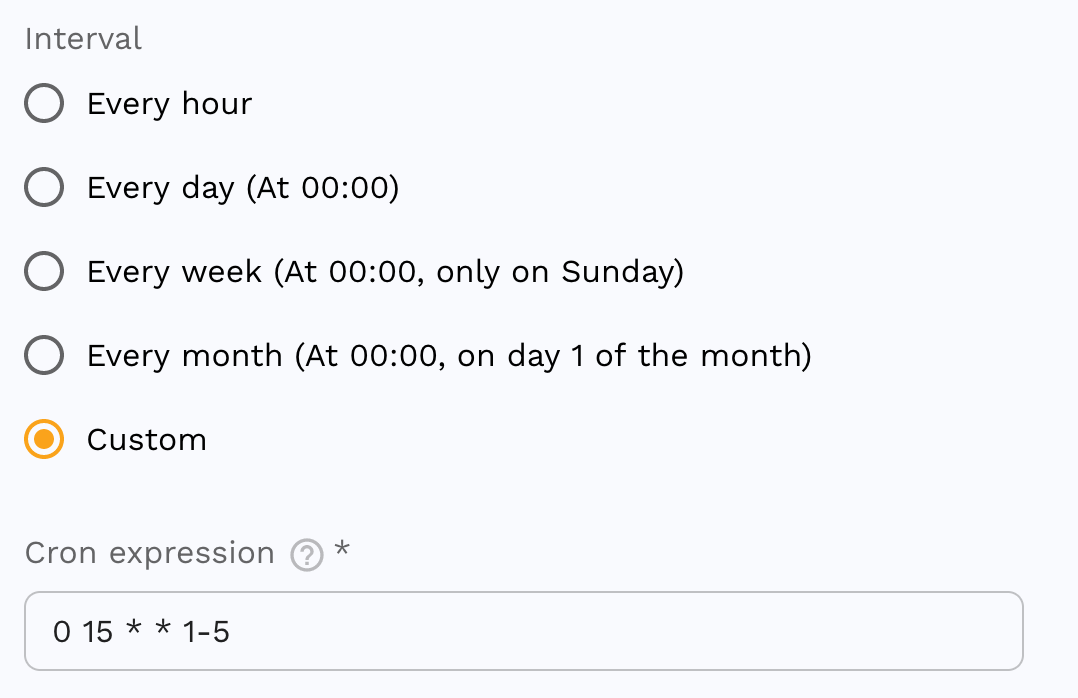
The cron expression here, 0 15 * * 1-5, defines a schedule which will run every
day at 15:00 UTC, Monday through Friday.
Visit crontab.guru for help creating and understanding cron expressions.
Actions
There are several actions to choose from which can be re-ordered as necessary.
Snapshot
Creates a fresh snapshot from a service running in your cluster. The service must have recorded traffic during the window specified or the snapshot will fail.
Replay
Runs a replay, generating a report, from an existing snapshot. The replay may use an existing snapshot, or one created from a previous action.
Sidecar
The Sidecar action applies only to existing sidecar deployments. New Kubernetes installations should use eBPF capture and control recording windows through capture targets or the capture.speedscale.com/enabled annotation.
Ensures the Speedscale sidecar exists, or does not exist, on a workload running in your cluster. A workload must have the sidecar attached to capture traffic. This action is useful for ensuring a workload is capturing traffic, or turning capture on and off to capture for a schedule without capturing traffic continuously.
The sidecar action asynchronously sends a command to add the sidecar to a workload but does not wait for it to complete. Traffic will also take up to 2 minutes to be visible in the Speedscale cloud after capture so it may be necessary to use a Wait action after the sidecar action to achieve consistent results.
Wait
Waits before advancing to the next action. This is useful for waiting for traffic after ensuring a sidecar exists on a workload, or when some out of band work is performed in between actions.
Notify
Sends a notification when the action is reached during execution. Place this action anywhere in the sequence, for example at the end to report the overall outcome, or immediately after a replay to alert on test failures.
Trigger conditions
| Trigger | When it fires |
|---|---|
| Always (default) | Every time the action is reached, regardless of prior results |
| On failure | Only when at least one earlier action in the job recorded an error |
| On success | Only when all earlier actions completed without error |
Channels
Webhook sends an HTTP POST to a URL you provide. By default the request body is a structured JSON object:
{
  "job_id": "my-job",
  "job_description": "Nightly regression",
  "execution_id": "3f7a...",
  "start_time": "2024-05-01T15:00:00Z",
  "status": "failure",
  "failed_tasks": [
    { "index": 1, "message": "Error: report completed with errors: [timeout]" }
  ],
  "snapshot_id": "abc123",
  "report_id": "def456",
  "schedule_url": "https://app.speedscale.com/schedules/my-job",
  "report_url": "https://app.speedscale.com/reports/def456"
}
To pass additional headers (for example, an authorization token) use the Headers field when configuring the action.
Message template
Some services, including Slack, require a specific JSON shape and will reject
the default payload. Set the Message template field to a
Go template string; when present the
request body becomes {"text": "<rendered>"} instead.
Available template variables:
| Variable | Description |
|---|---|
{{.JobID}} | Schedule ID |
{{.JobDescription}} | Schedule description |
{{.ExecutionID}} | Unique ID for this run |
{{.StartTime}} | Execution start time (UTC) |
{{.Status}} | success or failure |
{{.FailedTasks}} | Slice of failed actions; each has .Index and .Message |
{{.SnapshotID}} | ID of the most recent snapshot created in this run |
{{.ReportID}} | ID of the most recent replay report created in this run |
{{.ScheduleURL}} | Link to this schedule in the Speedscale dashboard |
{{.ReportURL}} | Link to the most recent replay report in the dashboard |
Slack
-
Create a Slack incoming webhook for the channel you want to post to and copy the webhook URL.
-
Paste the URL into the URL field.
-
Set Message template to a string such as:
*{{.JobID}}* finished with status *{{.Status}}*Started: {{.StartTime}}Schedule: {{.ScheduleURL}}{{if .ReportURL}}Report: {{.ReportURL}}{{end}}The dashboard's Use Slack default button pre-fills this template for you.
For failure details you can iterate over
FailedTasks:*{{.JobID}}* failed: {{range .FailedTasks}}task {{.Index}}: {{.Message}} {{end}}
Slack validates that the posted JSON contains a text field and returns
400 no_text without one, so the Message template field is required when
posting to Slack.
Email support is coming in a future release.
Combine the Notify action with On failure and continue_on_failure enabled
to get an alert any time a scheduled replay misses its goals without stopping
the rest of the job.